workshops on “Active Learning Techniques”
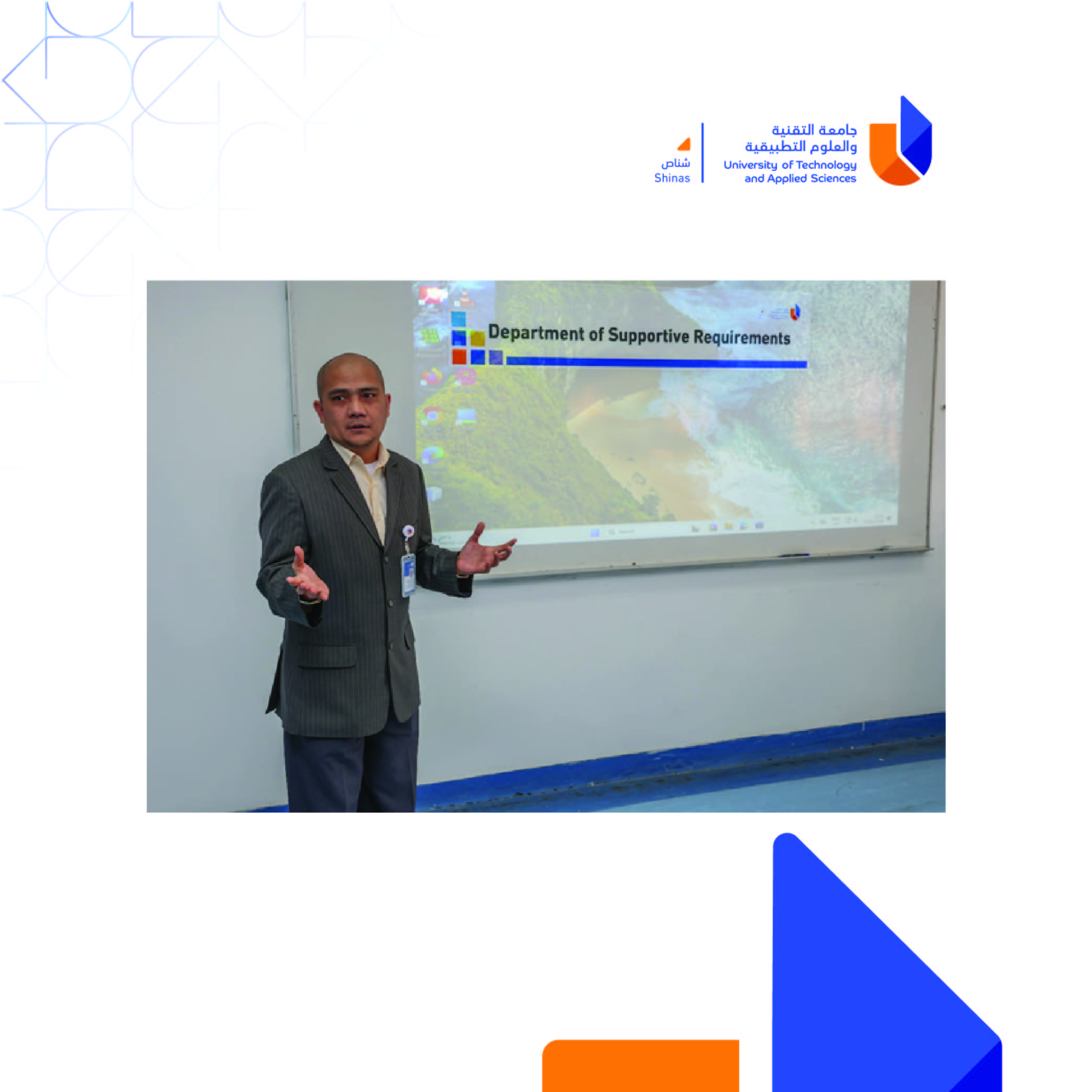
The Department of Supportive Requirements at the University of Technology and Applied Sciences (UTAS), Shinas,
successfully organized a series of professional development workshops on
“Active Learning Techniques” in January 2026. The sessions were coordinated by the Teaching and
Learning Committee (TLC) as part of its continuous efforts to enhance innovative teaching practices and promote
student-centered learning approaches across the department.
The first session was conducted on January 4, 2026, featuring Dr. Mahesh Garvandha,
who delivered an engaging presentation titled “Dynamic Mathematics: Visualizing Concepts with GeoGebra.”
During the session, he demonstrated how interactive digital tools and real-time visualization can support students
in understanding abstract mathematical concepts more effectively.
The session was followed by Dr. P. Vaidhyanathan, who presented
“Kahoot: Transforming Lessons with Game-Based Learning.” He highlighted how gamification
strategies can enhance student engagement, motivation, and formative assessment through interactive quizzes and
competitive learning activities.
The second workshop session was held on Sunday, January 11, 2026, from
10:00 AM to 1:30 PM. The program included a series of focused presentations by faculty members on
various active learning strategies. Dr. Kunjumol Vadakattu spoke on
Application-level Problem-based Active Learning, emphasizing real-world problem-solving techniques
to deepen conceptual understanding. Dr. Mohd Asim Siddiqui discussed
Active Learning in Engineering Education, highlighting innovative practices to strengthen analytical
and technical skills among students.
Dr. K. Madhu Sudhan Reddy presented on Spiral Learning / Spiral Curriculum,
explaining the importance of revisiting concepts progressively to enhance retention and mastery.
Mr. Ahammedul Kabeer addressed Productive Failure and Error-based Learning,
illustrating how constructive struggle can foster resilience and deeper learning.
Dr. Mushtaq Hussain delivered a session on From Passive to Active Learning,
focusing on transforming traditional lecture-based classrooms into interactive learning environments.
The workshop continued with Mr. Deogracias presenting on
Flipped Classroom Pedagogy, demonstrating how structured pre-class preparation combined with active
in-class engagement improves comprehension and participation. The final presentation was delivered by
Dr. Sulaiman Al-Reesi, Head of the Department, on Context-Rich Physics Problems,
showcasing the effectiveness of real-life contextual scenarios in strengthening critical thinking and conceptual clarity.
The workshop series was conducted under the leadership of Dr. Sulaiman Al-Reesi, Head of the
Department of Supportive Requirements. The program was coordinated by Dr. Mushtaq Hussain,
Teaching and Learning Committee Coordinator, with active support from committee members. Their collective efforts
ensured the smooth execution and success of the sessions.
15