UTAS Nizwa Conducts One-Week Community-Based Short-Term Course on Latest Trends and Branches of Artificial Intelligence
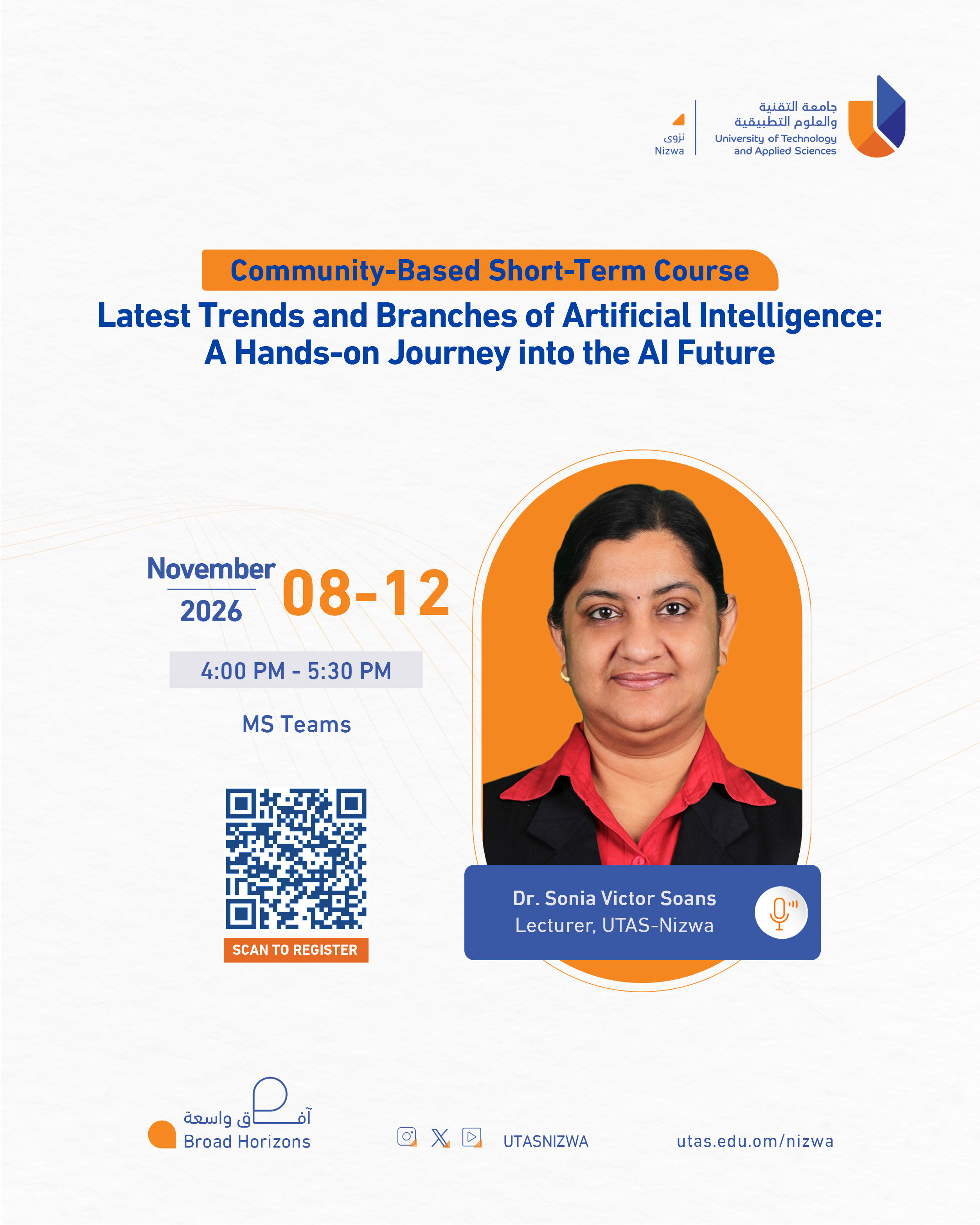
The University of Technology and Applied Sciences (UTAS), Nizwa, successfully conducted a One-Week Community-Based Short-Term Course on “Latest Trends and Branches of Artificial Intelligence: A Hands-on Journey into the AI Future” from 8 to 12 November 2026. Organized by the Professional Development Committee (PDC), Department of Computing and Information Sciences (DCIS), UTAS–Nizwa, the program was conducted online from 4:00 PM to 5:30 PM each day, targeting graduates from the community.
The program was conducted by Dr. Sonia Victor Soans, an academician, Artificial Intelligence researcher, and educator with approximately 30 years of experience in higher education, teaching, research, and academic leadership. She holds a Ph.D. in Artificial Intelligence and Computer Science, with research interests spanning Artificial Intelligence, Computer Vision, Machine Learning, Data Science, Generative AI, Trustworthy and Explainable AI, AI Ethics, and intelligent systems.
The five-day training program was designed to introduce participants to the latest developments, major branches, practical applications, and future opportunities in Artificial Intelligence through a combination of conceptual sessions, demonstrations, and hands-on activities.
The program covered five key areas over five days. Day 1 introduced participants to Artificial Intelligence, its fundamental concepts, evolution, and emerging branches, providing an overview of the rapidly expanding AI landscape. Day 2 focused on Machine Learning, Deep Learning, Neural Networks, Computer Vision, and other AI algorithms, highlighting how intelligent systems learn from data, recognize patterns, and solve real-world problems.
Day 3 explored Generative AI and practical AI tools for daily use. Participants were introduced to modern Generative AI applications and their capabilities in content creation, information processing, productivity enhancement, and everyday problem-solving. The session emphasized the effective use of AI tools for personal, academic, and professional activities.
Day 4 focused on Natural Language Processing, Agentic AI and real-world AI applications with Intelligent Project Development. Participants explored the emerging concept of AI Agents, their ability to perform tasks through reasoning, planning, and interaction with tools, and their potential applications across different domains. The session also highlighted how intelligent AI-based projects can be conceptualized and developed to address practical challenges.
Day 5 addressed Responsible AI, the latest trends, and future job opportunities. The session highlighted the importance of ethical and responsible AI adoption, including concerns related to bias, privacy, data protection, reliability, misinformation, and accountability. Participants also explored emerging AI trends, the changing employment landscape, and the growing demand for AI-related skills and career opportunities.
An important feature of the program was its emphasis on practical exposure and real-world applications. Through interactive demonstrations and hands-on activities, participants were encouraged to explore contemporary AI tools, understand different AI technologies, and identify opportunities to apply intelligent solutions to everyday and professional challenges.
The program aimed to equip graduates with essential AI-related future skills, enhance their digital competencies, and create awareness of emerging career opportunities in the rapidly evolving field of Artificial Intelligence. It also emphasized the importance of developing a responsible approach to AI adoption while understanding the opportunities and challenges associated with these transformative technologies.
The program witnessed participation from 66 attendees, and the participant satisfaction survey recorded an overall satisfaction level of 99%, reflecting the positive response to the training initiative.
Through this community-based training initiative, UTAS–Nizwa reaffirmed its commitment to extending knowledge and professional development opportunities beyond the university, strengthening university–community engagement, and promoting awareness of emerging technologies. The program also highlighted the important role of higher education institutions in preparing graduates with relevant future skills and competencies to contribute to Oman's digital transformation, knowledge-based economy, and the objectives of Oman Vision 2040.
Writeup by: Dr. Sonia Victor Soans
11