A research presentation on a Machine Learning-Based Cybersecurity Framework was organized by DCIS-Nizwa
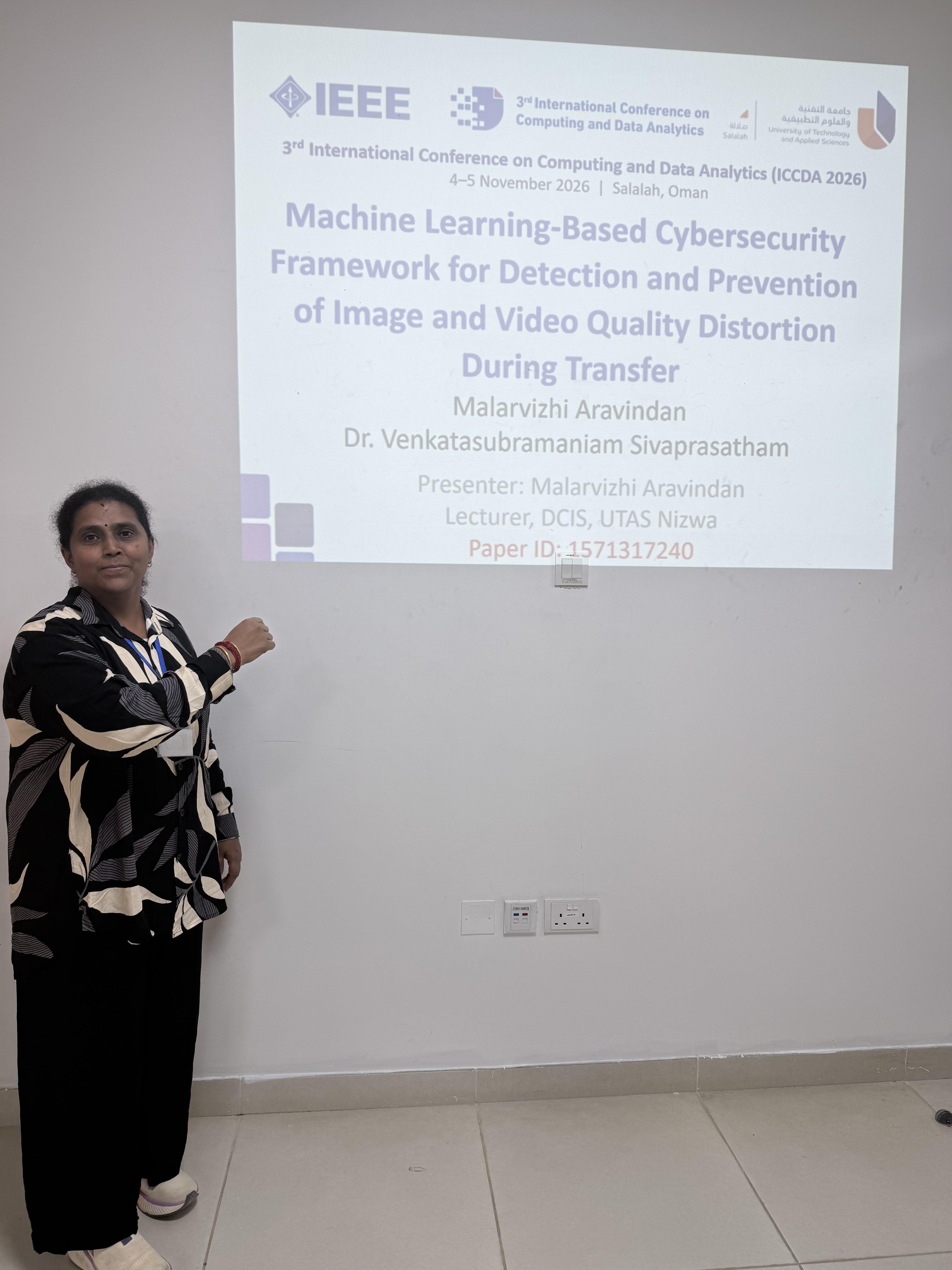
The Department of Computing and Information Sciences (DCIS), University of Technology and Applied Sciences (UTAS), Nizwa, organized a research presentation titled “Machine Learning-Based Cybersecurity Framework for Detection and Prevention of Image and Video Quality Distortion During Transfer” on Tuesday, November 17, 2026, from 12:15 PM to 1:15 PM at Room A134, UTAS Nizwa.
The session was attended by Dr. Maha Al Anqoudi, the Head of the Department, and Dr. Mohammed Ambusaidi, the Head of Unit in DCIS, UTAS, Nizwa.
The session was delivered by Ms. Malarvizhi Aravindan, an academician specializing in Digital Image Processing, Computer Networks, and Cybersecurity, with research interests in these areas. She also serves as an international editor and actively participates in international conferences. The presentation focused on emerging cybersecurity challenges associated with the unauthorized manipulation of digital images and videos during data transmission. While conventional security protocols primarily emphasize data confidentiality, they may not adequately detect subtle alterations affecting the semantic and structural integrity of digital media. In particular, the session highlighted threats such as bit-stream tampering and Man-in-the-Middle (MitM) attacks that can compromise image and video quality during transfer.
To address these challenges, Ms. Malarvizhi presented a Machine Learning-Based Cybersecurity Framework incorporating a dedicated security layer between the Transport and Application layers of the OSI model. The proposed framework consists of three key components: Real-Time Feature Extraction, a Machine Learning Anomaly Classifier, and a Prevention and Mitigation Engine. The research demonstrated promising results, achieving 98.4% detection accuracy through evaluations involving standard datasets and 5,000 simulated attack clips
The session provided participants with valuable insights into the practical applications of machine learning in cybersecurity, particularly in detecting and preventing digital media manipulation during transmission. It also highlighted the importance of integrating intelligent security mechanisms into communication systems to strengthen data integrity and protect multimedia content against evolving cyber threats.
The presentation was organized under the Professional Development Committee (PDC), DCIS, as part of its ongoing initiatives to promote research engagement, knowledge sharing, and professional development among academic staff. Dr. Sonia coordinated the activity, which was attended by DCIS staff members.
The session concluded with an interactive knowledge-sharing experience, enriching participants' understanding of the intersection of Artificial Intelligence, Machine Learning, and Cybersecurity and encouraging further exploration of intelligent solutions to contemporary cybersecurity challenges.
Writeup by: Dr. Sonia Victor Soans
20