Workshop Report on Building Cyber Resilience Against Malware Attacks
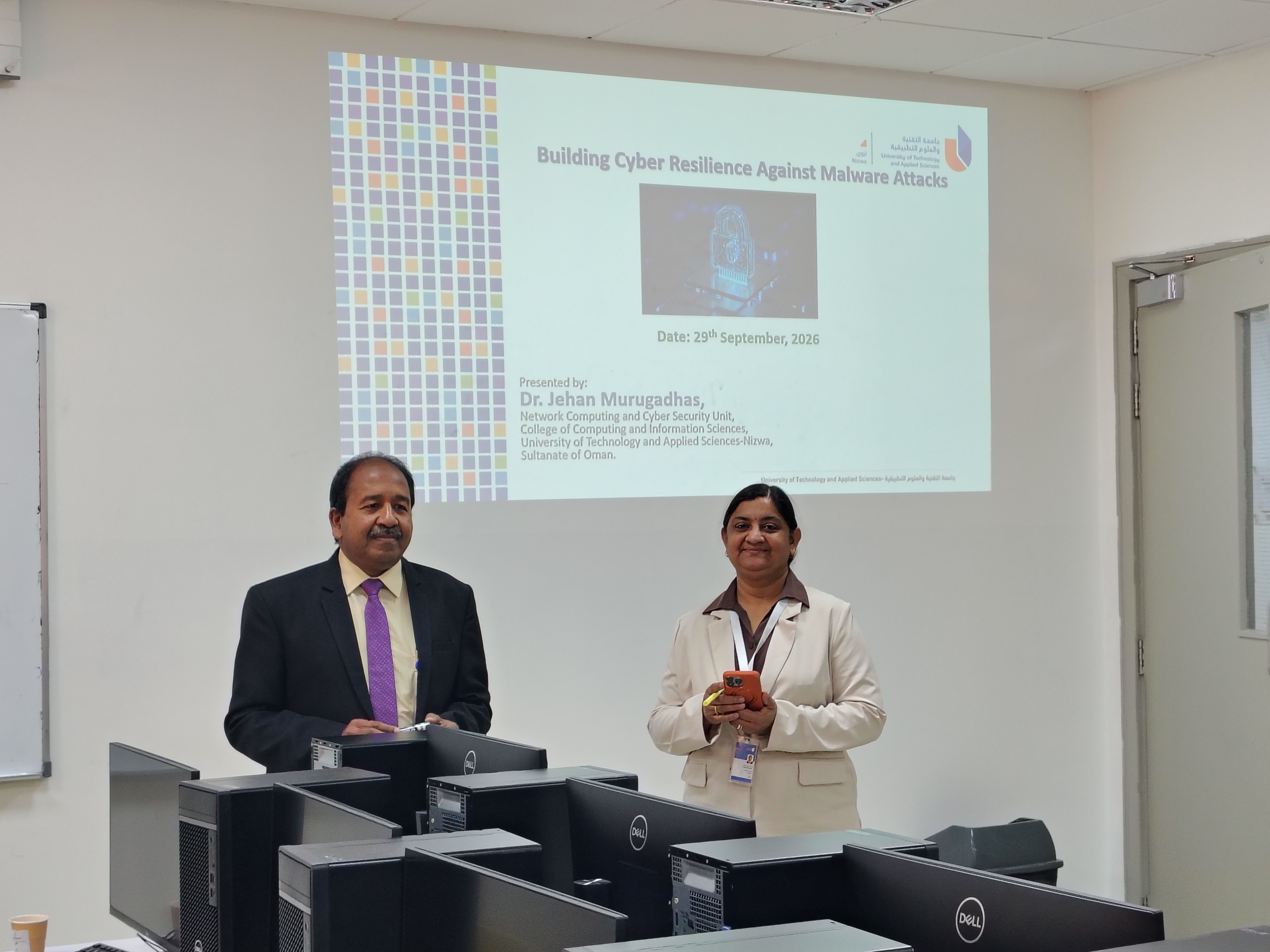
Under the leadership of Dr. Maha Al Anqoudi, Head of the Department, Ms. Zuweina Al Riyami, Head of Software Engineering Unit, and Dr. Mohammed Ambusaidi, Head of Network Unit, the Department of Computing and Information Sciences at the University of Technology and Applied Sciences (UTAS), Nizwa successfully conducted a professional development workshop titled “Building Cyber Resilience Against Malware Attacks” on Tuesday, September 29, 2026, from 12:00 PM to 1:00 PM at Room A133, UTAS-Nizwa.
The workshop was organized as part of the department’s professional development initiatives under the theme of Cyber Threat Intelligence, with a focus on strengthening staff capabilities in Future Skills, cybersecurity awareness, and organizational cyber resilience.
The session was delivered by Dr. Jehan Murugadhas, a Networking and Cybersecurity specialist with 26 years of experience in teaching and research. Dr. Jehan has extensive research experience in Mobile Ad Hoc Networks and has been actively involved in mentoring IoT-based applications and start-ups. He has also trained more than 25,000 professionals worldwide and has conducted numerous programs for universities, colleges, and research forums on Internet of Things (IoT), Disaster Recovery and Risk Management, Mobile Ad Hoc Networks, and related cybersecurity areas.
The workshop focused on the growing threat posed by malware, including ransomware, spyware, trojans, worms, and other malicious software, which can significantly affect organizational data, systems, networks, and business operations. Participants were introduced to key malware risk factors, attack vectors, vulnerabilities, and emerging cybersecurity threats.
During the session, participants explored practical strategies for reducing organizational exposure to malware attacks. Particular emphasis was placed on security awareness, endpoint protection, network security, vulnerability management, backup and recovery, incident response, and continuous monitoring as essential components of an effective cybersecurity strategy.
The workshop also highlighted the importance of developing a proactive cybersecurity mindset and strengthening organizational resilience. Participants were guided on how to identify common malware threats, assess organizational exposure, recognize security weaknesses, and apply appropriate prevention and detection techniques to protect systems, networks, and data.
In addition, the session addressed appropriate incident response, containment, and recovery strategies, enabling participants to better understand how organizations can minimize the impact of malware incidents and recover their operations efficiently. There was a hands on session added to this where he demonstrated how a malicious websites or links can be avoided. He also demonstrated the Encryption and decryption mechanisms.
The workshop contributed to UTAS-Nizwa’s continuing efforts to enhance staff competencies in emerging technological areas and to promote awareness of cybersecurity risks in an increasingly digital environment. It also supported the development of Future Skills by encouraging participants to adopt effective risk-management, monitoring, and cyber-resilience practices.
The successful completion of the workshop reflects the DCIS’ commitment to continuous professional development, cybersecurity awareness, and the effective adoption of emerging technologies and security practices across the campus. The event was coordinated by Mr. Shivashankar Rathinavelan, SDU, and provided an important platform for academic staff to strengthen their knowledge of contemporary cybersecurity challenges and organizational resilience.
Writeup by: Dr. Sonia Victor Soans
84