UTAS Nizwa Organizes International Webinar on “Text In, Text Out – Everything Else Is Engineering”
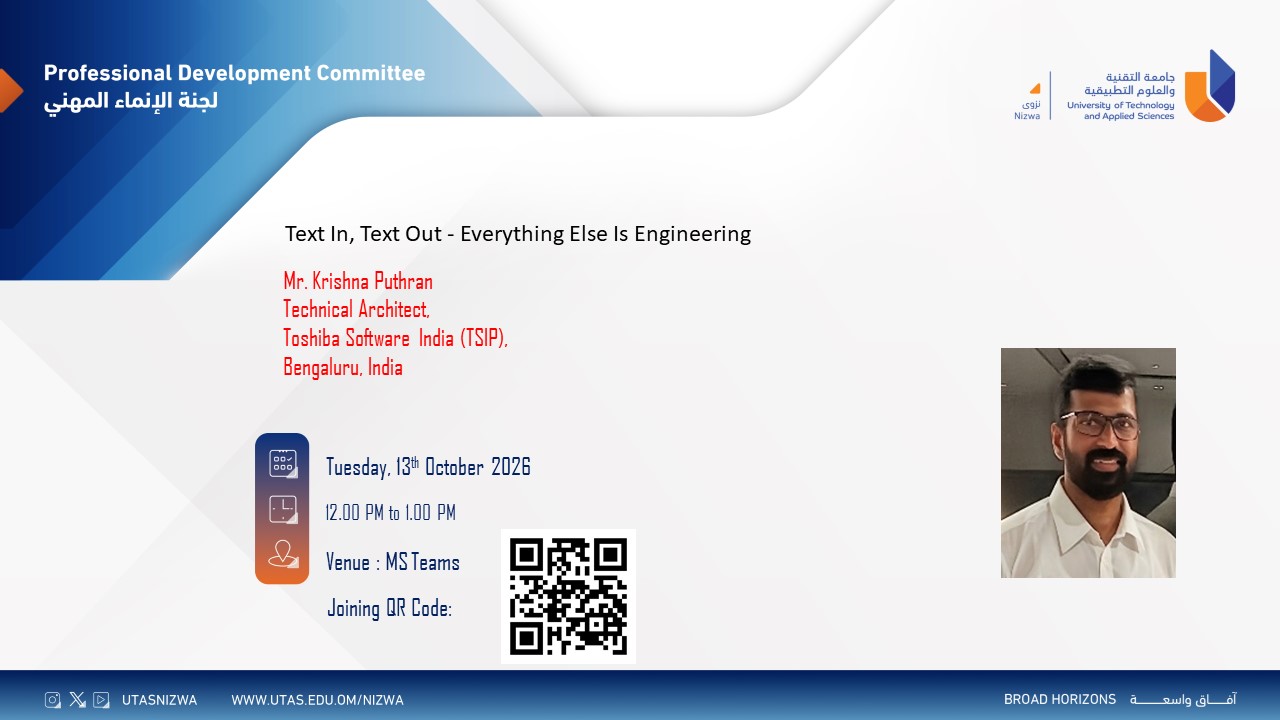
The Professional Development Committee (PDC) - DCIS of the University of Technology and Applied Sciences (UTAS), Nizwa, under the guidance of Dr. Faiza Al Dhuhli, Deputy Vice Chancellor and Chair of PDC, and with the supervision of Dr. Maha Said Khalfan Al Anqoudi, Head of the Department of Computing and Information Sciences (DCIS). Ms. Turkiya Al Busaidi, PDC Deputy Chair, organized an international webinar titled “Text In, Text Out – Everything Else Is Engineering” on Tuesday, October 13, 2026, from 12:00 noon to 1:00 p.m. The webinar was conducted online as part of the university’s professional development initiatives under the themes of AI-Powered Educational Technologies and Future Skills.
The session featured Mr. Krishna Puthran, Technical Architect at Toshiba Software India (TSIP), Bengaluru, India, as the resource person. With over 20 years of experience in software engineering and architecture, Mr. Puthran currently leads AI architecture initiatives for Toshiba Tec Japan. His work focuses on knowledge graphs, retrieval-augmented generation (RAG) systems, AI agents, and large language model (LLM)-based tools for enterprise retail and manufacturing platforms. He had previously delivered an engaging session for UTAS staff, and his return was a valuable opportunity for participants to explore recent developments in artificial intelligence.
The webinar addressed the growing influence of generative AI tools, such as ChatGPT, on teaching, learning, assessment, and industry expectations. Moving beyond the popular use of AI tools, the session offered participants a clear and practical understanding of the underlying concepts without unnecessary technical jargon or exaggerated claims about AI capabilities.
Mr. Puthran explained key concepts, including prompts, skills, agents, and agentic AI, highlighting their differences and practical applications. Using worked examples and a step-by-step investigation, he demonstrated how AI systems determine subsequent actions and how different components contribute to AI-assisted workflows. The session also highlighted the limitations of language models, particularly their tendency to generate fluent but potentially inaccurate responses, and emphasized the importance of human verification and responsible AI use
A significant focus of the webinar was the implications of these developments for higher education. The resource person discussed practical approaches to assessing programming assignments in an era when AI-generated code is readily available. He also highlighted the need to align curricula with evolving industry requirements and help students develop the technical knowledge, problem-solving abilities, critical thinking, and verification skills expected by employers.
The webinar provided an opportunity for academic staff to strengthen their understanding of contemporary AI terminology and technologies and to reflect on how these developments could influence teaching strategies, assessment design, curriculum development, and student preparedness for future careers.
The event was coordinated by Dr. Sonia Victor Soans on behalf of the Professional Development Committee. The event concluded with appreciation to Mr. Krishna Puthran for sharing his expertise and practical insights, and to all participants for their active involvement. The initiative reflects UTAS Nizwa’s continued commitment to professional development, digital transformation, responsible AI adoption, and the preparation of students and academic staff for the evolving demands of the digital era.
Writeup by: Dr. Sonia Victor Soans
63