Brains, Brands, and Buying – A Neuromarketing Journey
Brains, Brands, and Buying – A Neuromarketing Journey
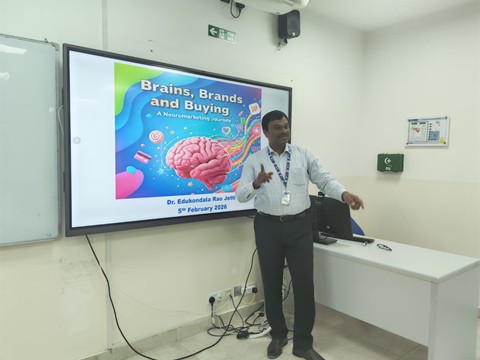
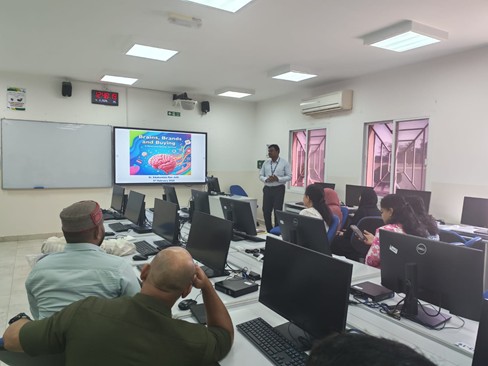
“How neuromarketing can be harnessed to build stronger brands and influence consumer behavior effectively?” This key question was addressed during the workshop organized by the Department of Economics and Business Administration entitled “Brains, Brands, and Buying: A Neuromarketing Journey” on February 4, 2026, at 1:00 PM in BS133. The session was facilitated by Dr. Edukondala Rao Jetti, who provided participants with an in-depth exploration of neuromarketing and its role in understanding consumer behavior.
The workshop was designed to strengthen specialization skills and foster creative thinking skills, equipping attendees with the ability to connect neuroscience with marketing strategies. Dr. Edukondala Rao Jetti emphasized that nearly 80% of buying decisions are subconscious, highlighting the importance of visuals, emotions, and storytelling in influencing consumer choices. He noted that narratives, humor, and nostalgia often outperform plain product descriptions, underscoring the power of emotional engagement in marketing.
Through case studies—including analyses of the “It’s a Boy” advertisement, the Brussels Airlines sequel ad, and the Fair & Lovely campaign—participants examined how emotional triggers, cultural perceptions, and continuity in messaging shape consumer attitudes and brand loyalty. The session also introduced tools borrowed from neuroscience and psychology, reinforcing that neuromarketing is research-driven and not intrusive. A key insight shared was that “the eye guides the brain before logic kicks in,” emphasizing the primacy of visual and emotional cues in consumer decision-making.
By combining theoretical foundations with practical examples, the workshop reinforced the institution’s commitment to advancing specialized knowledge and innovative approaches in business education. Participants left with a deeper appreciation of how neuromarketing can be harnessed to build stronger brands and effectively influence consumer behavior.
SDC – DEBA

220